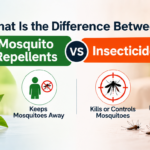
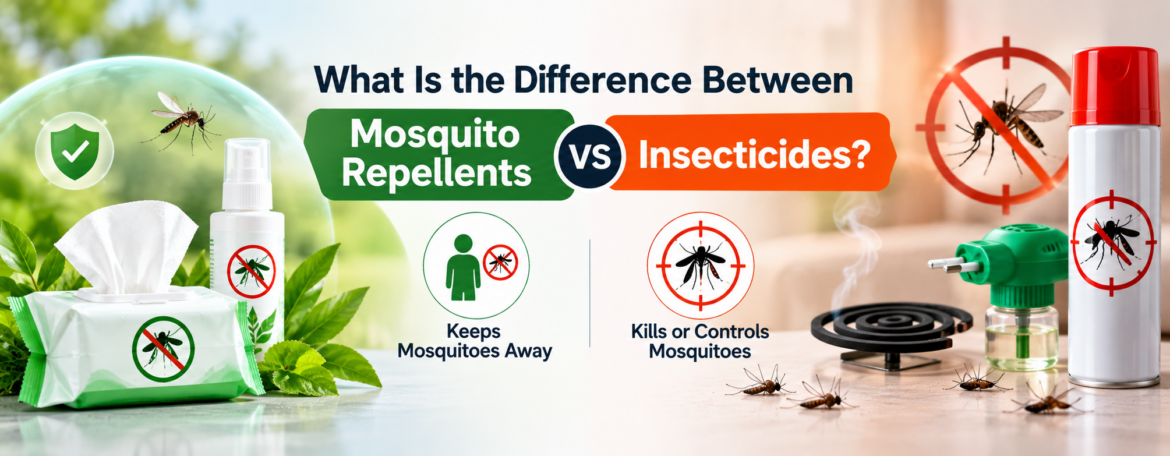
Mosquito repellents and insecticides serve different purposes. Repellents help keep mosquitoes away from people or treated surfaces, while insecticides are designed to kill or control mosquitoes and other insects. For businesses developing mosquito-control products, a Mosquito Repellent Wipes Manufacturer can provide convenient wipe-based solutions for personal protection.
Mosquitoes are more than an everyday nuisance. They can transmit diseases such as dengue, malaria, chikungunya, yellow fever, and West Nile virus in different parts of the world. Because of this, mosquito-control products are commonly used in homes, workplaces, outdoor areas, and during travel.
Two commonly used categories are mosquito repellents and insecticides. Although both are intended to reduce mosquito-related problems, they work in fundamentally different ways.
Understanding the difference is important when choosing a product for personal protection, household mosquito control, commercial applications, or product development.
What Are Mosquito Repellents?
Mosquito repellents are products designed primarily to discourage mosquitoes from approaching or biting people or animals.
Rather than killing mosquitoes, repellents generally interfere with the insects’ ability to detect or locate a person. Depending on the active ingredient and formulation, a repellent may make the treated person or area less attractive to mosquitoes.
Common forms include:
- Repellent creams and lotions
- Sprays
- Roll-ons
- Repellent patches
- Repellent wipes
- Clothing treatments
- Mosquito-repellent devices
Repellents can be particularly useful when the primary goal is personal protection while spending time outdoors.
What Are Insecticides?
Insecticides are substances formulated to kill, control, or reduce insect populations.
Unlike repellents, which generally aim to prevent mosquito contact, insecticides target mosquitoes or other insects directly. Depending on the product, they may affect an insect’s nervous system, growth, reproduction, or other biological processes.
Insecticides can be found in products such as:
- Aerosol sprays
- Mosquito coils
- Vaporizers
- Fogging formulations
- Residual surface treatments
- Larvicides
- Certain household insect-control products
The appropriate product depends on the target insect, application area, formulation, and applicable safety and regulatory requirements.
Mosquito Repellent vs. Insecticide: Key Differences
| Feature | Mosquito Repellent | Insecticide |
|---|---|---|
| Primary purpose | Keeps mosquitoes away | Kills or controls insects |
| Main target | Mosquito behavior | Insect population |
| Prevents bites | Yes, when properly used | Not necessarily |
| Designed to kill mosquitoes | Generally no | Yes |
| Common applications | Personal protection | Household, commercial, and environmental control |
| Examples | Wipes, lotions, sprays | Coils, aerosols, larvicides |
| Typical objective | Avoid mosquito contact | Reduce or eliminate insects |
The biggest difference is therefore repel versus control or kill.
How Do Mosquito Repellents Work?
Mosquitoes use several sensory cues to locate potential hosts, including body odors, carbon dioxide, heat, and other chemical signals.
Certain repellent ingredients can interfere with these cues, making it more difficult for mosquitoes to recognize or approach the treated person.
The effectiveness and duration of protection depend on several factors, including:
- Active ingredient
- Concentration
- Product formulation
- Amount applied
- Exposure to water or sweat
- Temperature and environmental conditions
- Mosquito species
- Reapplication requirements
This is why users should always follow the product label rather than assuming that every repellent provides the same duration of protection.
How Do Insecticides Work?
Insecticides are designed to affect insects through specific biological mechanisms. Different insecticides can have different modes of action.
Some may affect the insect nervous system, while others interfere with development or other physiological processes.
For mosquito management, insecticides may be used against:
- Adult mosquitoes
- Mosquito larvae
- Mosquitoes resting on treated surfaces
The correct application depends on the product and its intended use. Products should be used strictly according to their approved instructions.
Why Are Repellent Wipes Becoming Popular?
Repellent wipes offer a convenient alternative to conventional sprays and lotions.
They can be useful because they are:
Easy to Carry
Individual wipes can be packaged in compact sachets, making them convenient for travel, outdoor activities, camps, events, and everyday use.
Simple to Apply
A pre-moistened wipe can provide controlled application without requiring users to carry a spray bottle or lotion container.
Convenient for Travel
Individually packed wipes can fit easily into handbags, backpacks, travel kits, and emergency supplies.
Suitable for Different Product Strategies
Businesses can develop wipe-based products for specific markets and customer requirements, subject to appropriate formulation, testing, labeling, and regulatory compliance.
For businesses entering this category, working with an experienced Mosquito Repellent Wipes Manufacturer can help with product formulation, substrate selection, packaging, production, and private-label requirements.
Can Repellents and Insecticides Be Used Together?
In some mosquito-control programs, repellents and insecticides may have complementary roles.
For example, an insect-control program may focus on reducing mosquito populations in a particular environment, while individuals may use an appropriate repellent for personal protection.
However, these products should not automatically be mixed or combined. Each product should be used according to its label, intended application, and safety instructions.
Which One Should You Choose?
The right choice depends on the objective.
Choose a mosquito repellent when:
- You want to reduce mosquito approaches or bites.
- You are spending time outdoors.
- You need a personal protection product.
- You prefer a portable product such as wipes or lotion.
Consider an insecticide when:
- The goal is to kill or control insects.
- You need household or environmental mosquito control.
- You are addressing mosquito populations rather than simply protecting one person.
In many situations, mosquito management works best as part of a broader approach that includes reducing standing water, using physical barriers such as screens, wearing suitable clothing, and using appropriate mosquito-control products.
Factors to Consider When Choosing a Mosquito Repellent
Before purchasing a repellent, consumers should consider:
1. Active Ingredient
Check the active ingredient and its concentration. Different ingredients can provide different levels and durations of protection.
2. Intended User
Some products are formulated for specific age groups or applications. Always check the product label before use.
3. Duration of Protection
Protection time can vary based on formulation, activity level, sweating, water exposure, and environmental conditions.
4. Application Method
Sprays, lotions, wipes, and other formats offer different application experiences. A wipe may be particularly convenient for controlled, portable application.
5. Label and Regulatory Information
Always check whether the product is appropriately labeled and registered or approved for its intended market and use.
Factors to Consider When Choosing an Insecticide
When selecting an insecticide, consider:
- Target insect
- Intended application area
- Active ingredient
- Application method
- Required protection period
- Safety instructions
- Environmental considerations
- Regulatory requirements
Using more product than recommended does not necessarily provide better protection and can create unnecessary exposure or environmental concerns.
Repellent Wipes and Product Development
The growing demand for convenient mosquito-control products has created opportunities for businesses looking to develop private-label or customized repellent wipes.
Product development may involve several stages, including:
- Selecting the appropriate formulation
- Choosing suitable wipe material
- Determining packaging requirements
- Conducting stability and quality testing
- Reviewing labeling requirements
- Manufacturing and quality control
- Packaging and distribution
Businesses should work with qualified manufacturers and ensure that the finished product meets the regulatory requirements of the market where it will be sold.
Common Misconceptions About Repellents and Insecticides
Myth 1: Repellent and insecticide mean the same thing.
They do not. A repellent primarily aims to discourage mosquitoes from approaching or biting, while an insecticide is designed to kill or control insects.
Myth 2: A stronger smell always means better protection.
Not necessarily. Effectiveness depends on the active ingredient, formulation, concentration, application, and other factors—not simply how strong the product smells.
Myth 3: More product means longer protection.
Applying more than the recommended amount is not a reliable way to increase protection and may increase unnecessary exposure.
Myth 4: Every mosquito-control product works against every mosquito species.
Effectiveness can vary by product, mosquito species, application method, and environmental conditions.
FAQs
1. What is the main difference between mosquito repellent and insecticide?
A mosquito repellent is primarily intended to discourage mosquitoes from approaching or biting, while an insecticide is intended to kill or control mosquitoes or other insects.
2. Do mosquito repellents kill mosquitoes?
Generally, repellents are designed to repel rather than kill mosquitoes. Their primary purpose is to reduce mosquito contact with the treated person or area.
3. Are mosquito-repellent wipes effective?
A properly formulated and appropriately used repellent wipe can provide personal mosquito protection. Effectiveness depends on the active ingredient, concentration, application, and other environmental factors.
4. What are common forms of mosquito repellents?
Common formats include lotions, creams, sprays, roll-ons, patches, treated clothing, and wipes.
5. What are common forms of insecticides?
Insecticides may be available as aerosols, coils, vaporizers, residual treatments, fogging products, and larvicides, depending on the intended application.
6. Can mosquito repellents and insecticides be used together?
They can have complementary roles in mosquito management, but each product should be used according to its specific label and safety instructions. Products should not be mixed unless the label specifically permits it.
7. What should businesses consider when developing mosquito-repellent wipes?
Businesses should consider formulation, active ingredients, wipe substrate, packaging, product stability, testing, labeling, regulatory requirements, and manufacturing quality.
8. How can businesses find a mosquito-repellent wipes manufacturer?
Businesses should evaluate manufacturers based on relevant manufacturing experience, quality systems, formulation capabilities, testing, packaging options, production capacity, and compliance with applicable regulations.
Mosquito repellents and insecticides both play important roles in mosquito management, but they are designed for different purposes. Repellents focus on keeping mosquitoes away, while insecticides focus on killing or controlling insects. Understanding this difference helps consumers select suitable products and helps businesses develop products that match specific market needs.
For companies planning to launch convenient personal-protection products, partnering with a reliable Mosquito Repellent Wipes Manufacturer can support the development and production of suitable wipe-based solutions while addressing quality, packaging, and applicable regulatory requirements.
Stay tuned here for more updates!